
Flag of Australia
The southern sky and the idea of federation meet on the same flag.
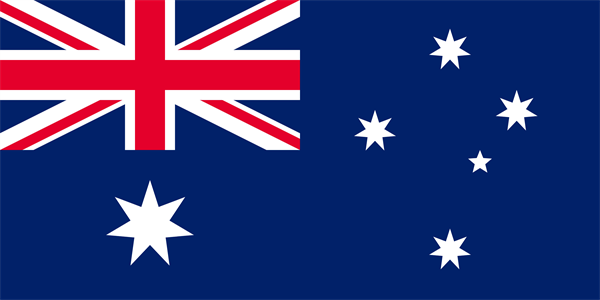
- Adopted and changed
- First adopted 3 September 1901; the current large star 1908; legal definition 1954
Design
A navy-blue field with the Union Jack in the upper left, a large seven-pointed star beneath it, and the five stars of the Southern Cross on the right.
What it means
The Union Jack represents the historical tie with Britain, and the large Commonwealth Star represents the six states and the territories. The Southern Cross is linked to Australia's position in the southern hemisphere.
The story
After the federation was founded in 1901, a flag competition was held. Five very similar designs won together. At first the large star had six points; in 1908 a seventh point was added to represent the territories. The national status of the blue-field flag was clearly defined when the Flags Act 1953 came into force in 1954.
Sources: pmc.gov.au, nma.gov.au, peo.gov.au
Flag of New Zealand
The four red stars show New Zealand's southern sky.
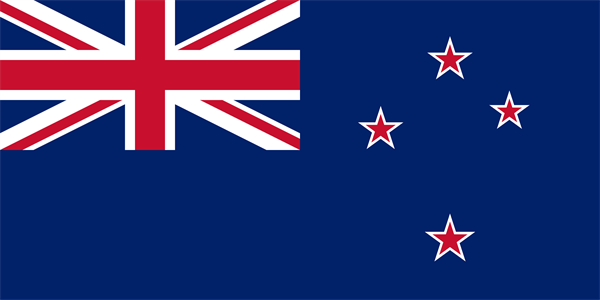
- Adopted and changed
- Official national status in 1902; the maritime precursor of the design dates from 1869.
Design
A dark blue field with the Union Jack at the upper left and four red stars edged in white on the right.
What it means
The Union Jack stands for the historical link with Britain; the stars represent the Southern Cross constellation and the country's position in the Southern Hemisphere.
The story
The design developed from the British blue ensign tradition. The version distinguished by the stars of the Southern Cross gained national flag status in 1902. In 2015–2016, whether to move to a new design was debated through referendums. In the final vote, a majority of voters preferred to keep the existing flag.
Sources: Flags of the World (specialist archive), nzhistory.govt.nz
Flag of New Caledonia
Special collectivityDepends on the context
In New Caledonia, the French flag and the Kanak flag have different statuses.
A special-status territory attached to France; the statuses of the French national flag and the Kanak flag must be kept separate.
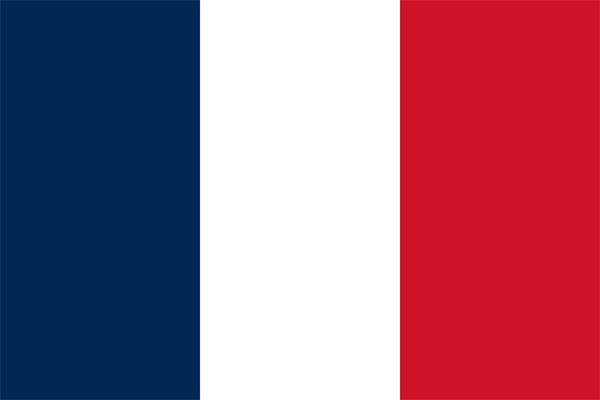
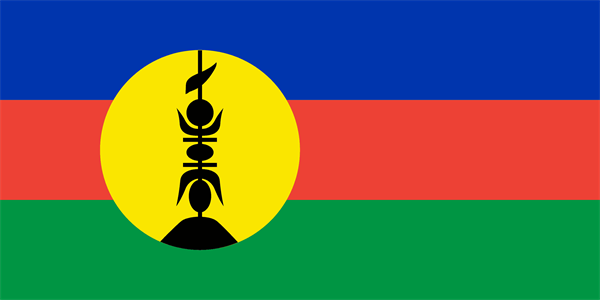
- Type
- Special collectivity
- Adopted and changed
- The French flag is the official national symbol; the Kanak flag dates from 1984, and the practice of flying them together became widespread from 2010
Design
The French blue, white and red; the separately used Kanak flag has blue, red and green stripes and a yellow disc containing a black roof ornament.
What it means
On the Kanak flag, blue represents the sky and sea, red the struggle and unity, green the land and ancestors, and yellow the sun. The black shape represents the finial of traditional Kanak houses.
The story
The flag created by the FLNKS in 1984 became identified with Kanak identity and the independence movement. In 2010, the Congress passed a non-binding resolution expressing a wish for the two flags to be flown together. A 2025 statement by the French government stresses that the French tricolour is the only official national symbol and that a joint local flag has not yet been determined.
Versions and context
- French national flag: Vertical blue, white and red tricolour; the official national symbol.
- Kanak / FLNKS flag: Blue, red and green stripes, a yellow disc and a black roof ornament; there are practices of flying it alongside the French flag, but it does not have the same official status.
Sources: questions.assemblee-nationale.fr, Flags of the World (specialist archive)